Monday, April 20, 2015

Reality of Japan

Now after living in Tokyo for a period of time I can start to see the reality of what the general belief-system and lifestyle here entails for the average person. Although outwardly portrayed as a technology-advanced utopia with an excellent standard of living and a seemingly peaceful people; the dark underbelly of Japan remains, even growing at an unsustainable rate. How can this be so? Many of you have seen links on my Facebook page concerning the reality of Japan. Here again are the links that show the reality of Japan:

 Japan is Literally Working itself to death
 Where did all the Japanese Fathers go?
 Japan's Disposable Workers 
Japan's Birthrate Decline


At what cost comes success in Japan? Or for that matter at what cost does it take just to raise a family in an increasingly competitive Japanese society in which human value is measured mostly by usefulness much in an entirely utilitarian sense. Can you sense the distress a little more clearer now? Can you see why a “First World” country needs Christ just as much as any other country. I hope so, because the people here are literally dying physically as well as spiritually.

In Tokyo when human beings are reduced to only the belief in the physical existence without regard to the truths of the scriptures, their only hope can be found in an increasingly dehumanizing system of “survival of the fittest” by somehow coming out on top in the Japanese societal structure. Only for many it comes at the cost of their bodies breaking down, death, suicide, or other various addictions. But, if this is how you are taught to believe reality is, then how do you escape? The term "Shikata ga nai" comes to mind, which means "it cannot be helped".  This is the reality of doing ministry in the urban landscape of Japan. Many people here know that there is an issue, that something is not right, that there is more to life than the physical existence; many often just continue in their existence thinking that this is the extent of their life. Many Japanese people that we meet have interest in Christianity, and would become Christians if someone had the time to sit down with them an explain the scriptures in detail. This has happened with the few people that we have been able to devote appropriate time to.


This is where the Japanese church as a whole comes in. But, if the church is comprised of many mentally sick, weary, spiritually-oppressed, elderly, new-in faith, and over-worked people, then how can it be expected to complete the task of the gospel? (For most men work very long salary-man hours to support their family and do not have much time for spiritual matters, as they are just trying to survive.) The church needs help. It needs prayer support, God-called missionaries, and humble servants in the church to prayerfully combat in spiritual warfare. The church needs Japanese servant-leaders who will come along side the people to help them (rather than command them) throughout this country, for the potential is great. Will you pray for this?

Thursday, March 26, 2015

The Outsiders

In Tokyo exist many members of various people groups from around the planet. Just as in most major American cities, these various people groups exist in small pockets throughout the city. Of major notable areas are Yokohama Chinatown and Shin-Okubo.


Chinese and Koreans are the largest people groups residing in Japan. In much smaller regards live many various peoples from Asia, Europe, and North America. In our time here in Tokyo we have noted that the common language seems to be English, as it is known to be the language of business worldwide. Though many Asian nations do not appear to be as free in regard to practice of religion as in Japan and South Korea, it should be noted that missionaries have great access to people groups from these more “hostile” countries from right inside Tokyo. In Japan there are nearly 700,000 Chinese people, but I wonder how many missionaries are working with them? Especially when it is much easier for a Westerner to come to Japan and work as opposed to China!

But, of more interest has been our experiences in our very own language school learning Japanese. Katie and I have been able to speak with many different people from around Asia studying at this school, with a notable percent who have never heard anything about Christianity. For instance many Malaysian students speak English very well, have interest in Christianity, but have had little access to Christians as their country is relatively closed. In more recent times Katie has been ministering to Malaysian, Japanese, Chinese, and American people with interest in the gospel. Whereas I have been ministering with a Chinese and Malaysian man. All this is possible with our common bond of speaking the English language. Please pray for these people.

Now consider your own city. How many different people groups exist in your home area? I recall in Missoula that the University had hundreds of people from all around the world. This was where I met my first two Japanese friends a few years ago as part of an international friendship program. For many international students meeting an American family who is Christian will be their very first exposure to Christianity. Seriously consider taking the time to look into your area for resources for contacting foreign visitors, it may be life changing.


Saturday, February 14, 2015

Church Experience in Japan

Now having lived in Japan for close to five months I am sure many would like to know what exactly church is like here based upon personal observation. (From the prospective of an American who has been associated with Baptist-oriented churches for his entire adulthood.) The purpose of this post is informative, not to be used for unwise comparison.

The church that I have been attending recently celebrated its 50th anniversary.  This church was apparently founded by Baptist Missionaries from American in 1957 who after a period of time turned the church over to a Japanese national pastor. This era in which the church was founded was still in a time of great pioneer missions in Japan after World War 2 where missionaries were encouraged to come to this country and found new churches. That generation of much-needed pioneer missionaries are now long gone. Today some pioneer missionaries exist in unreached areas of Japan, however most modern missionaries in Japan appear to be working together in already existing para-church organizations or with established churches. A few years before I came here the previous pastor retired, and a new pastor named Elisha started to pastor the church after receiving a seminary education in the United States. (Even after retiring the previous pastor is still preaching at another local church temporarily. The average Japanese pastor age is something around 60 years old.) Now with a regular attendance of anywhere from 200 to 300 people each Sunday this church is apparently a rare exception to the average Japanese church which is said to have about 30 people. So, what is it like here?


Immediately upon coming here it can be noticed that many people are busy doing many tasks at the church. From my observations the Japanese people appear to be very task-oriented whether in church or out of church. (Japanese are known to be an industrious people.) Many are involved in teaching, disciple making, church maintenance, and other various functions. Men who are active in the church often work “salary man” hours during the week (7am to 10pm Monday through Friday), then come in and do church activities until late evening on Sunday. (Not every man is like this, however many are.) From what I have seen these men do this not because they have to, but because they are passionate about their church. To them, this is normal life. Sunday consists of three services (9am, 10:45am, and 1:30pm) with a Sunday school for children (9am) downstairs as well as a teen service (10:30am) downstairs. At 12:00pm lunch is prepared every Sunday after the teen service downstairs by volunteers and is partly subsidized by the church. It costs each person about $2.00 with first time guests eating free. Different groups are assigned to clean up after lunch each week. The teenagers actually clean once a month! Everything appears to transition quite quickly as well as smoothly as everyone knows what is expected of them without having to be told what to do. No one has to come and check to see if the cleaning job was completed or not completed.

After lunch the third service (1:30pm) occurs for those who have not attended either of the other two previous services. This third service is geared toward new-comers. For the rest of the people who have already attended one of the previous services groups by division of age and gender gather together for a period of bible study. Some that are not involved in groups are involved in one-on-one discipleship. Mostly new believers are discipled for a long period of time (4-6 months) so that they can understand Christianity thoroughly before becoming Baptized and later joining the church. Apparently in this land in the past people who got baptized believed that their duty to church was done, and decided to leave, so the 4-6 month education period was placed to prevent this from occurring. Though the church has three floors with various rooms one would think that there would be plenty of space to do the activities, however each room is claimed for long periods of time by various groups. This church makes excellent use of the building as well as the rooms on Sunday as well as the entire week! During the week various groups meet for discipleship, staff meetings/tasks, prayer, and an English program called ‘Kids Brown’. I am sure many other events take place at the church of which I am unaware of due to my time at language school during the weekdays. Also, on Wednesday each week at 8:00pm some church members get together for a short devotional and prayer meeting. Given the lack of space the church has purchased property next door and plans on building a second building for the purpose of more rooms for church related teaching, discipleship, and various ministries. Given that Japan’s population is rapidly aging, this church has decided also to build a dedicated area for taking care of senior citizens as a ministry. On another blog I will speak more of Japanese church! Feel free to comment below or email me a question about church in Japan. Blessings!

Thursday, January 8, 2015

Ancient Japanese Judeo-Christian Influences

Many people would be interested to know that an ancient Judeo-Christian heritage existed in places such as India, China, and Afghanistan as well as other countries in Asia. With some research you can find out about these topics in greater detail. I would recommend looking into this as it may change some of your preconceived ideas about the beliefs of these areas. However, today I would like to focus specifically on Japan’s ancient Judeo-Christian influences. On a previous blog I indicated that I would speak more about the connection with Judeo-Christian heritage in Ancient Japan. Many of you know about the history of Christianity in Japan, however there are other areas in which you may not be familiar with.  Here are some links to interesting articles:

Nestorian Christianity in Japan

CBN Article

Japan Times Article


Research about Ancient Israelite influence on Japanese Culture

Israelite Link


Here is a personal picture that I took at a train station in Tokyo. As noted in the above article these ‘God boxes’ were similar to the ark of the covenant in many ways. As empires come and go throughout history it is interesting to find artifacts that seem to show Judeo-Christian influences in Japan. Here are some links to a Japanese Documentary about these influences in Japan:

God's Fingerprints in Japan 1

God's Fingerprints in Japan 2

I hope that these resources help to see Japan in a different light. Tell me what you think!

Wednesday, December 24, 2014

Christmas in Japan

Merry Christmas everyone!

By special request from my dad I am going to take some time to make a quick post about what Christmas season in Japan is like. Here in Tokyo it is quite apparent from daily observation that there is much American influence for the Christmas season. This was apparently inherited from the post-war years from what I have heard. It is apparent that the Japanese people really enjoy Christmas, or at least the Americanized Non-Christian ‘Material-mas’ version. Although they do not get Christmas day off, they do get Emperor’s birthday off on December 23rd. Just like America most major stores here began to play Christmas music as well as display Christmas advertisements in November. Merry Christmas or Merry X-Mas are most common in advertising. The Japanese do not seem to have a problem with saying ‘Christmas’ instead of ‘Happy Holidays’. Many city areas have Christmas lights as well as trees or wreaths.


Kodiara City


Mall near Shinjuku Station in Tokyo

I do want to note that many stores actually play spiritual Christian-themed Christmas music about Christ’s birth, which would probably be taboo in America these days! I have learned that there are some distinct features about Japanese Christmas that may seem amusing in the Western World. Apparently Kentucky Fried Chicken (or some form of fried chicken) is consumed on Christmas Day. Also, Christmas Eve is a day for ‘happiness’ and the exchanging of presents. Apparently the Japanese have a Buddhist monk equivalent to Santa Claus who gives gifts.


Chicken at Japanese 'Walmart'


Christmas Chicken Advertisement

'7-11' Style Gift Box

Around this time of year many expensive gift packs are seen in stores. Here in Japan the local ‘7-11’ has an expensive catalog containing various Christmas cakes, wines, and expensive food gift packs. In America to go to ‘7-11’ for a Christmas gift would be a joke, however here ‘7-11’ is seen in a different light! Of course this has been an excellent time to hand out gospel tracts to various people to explain the meaning of Christmas as well as invite people to our church. Our church did an in-house Christmas concert with close to twenty separate groups as well as a traditional Christmas Eve service!


Christmas Eve at Church


Christmas Eve Snacks at Church

Thank you for your prayers!

Sunday, December 7, 2014

Shintoism in Japan - Shrine Experience

Here in Japan one of the most common belief systems is that of Shintoism. I am sure that many people (including myself) are curious about what this belief system entails. As I am here longer in this country I am sure that I will have more time to study this Japanese philosophy of life in greater detail since it is at the center of Japanese understanding of life. Recently, Katie and I were able to have some first hand encounters with Shintoism by going to Yoyogi Park in Tokyo during Japan’s “Labor Thanksgiving Day”. Some of you may have seen the pictures on Katie’s facebook page. We went to Yoyogi park because of its close location, free attendance, and close proximity to Harajuku street (popular area in Tokyo). Unbeknownst to me is that within Yoyogi Park is the Meiji Shrine, which is a large shrine that apparently dedicated to the ‘deified spirits’ of Emperor Meiji and Empress Shoken. The Meiji era in Japan was considered to be one of the most vital times in this country’s history, so this shrine is very well beloved. In 1920 this shrine was constructed for the purpose of enshrining their souls. I do not entirely know what this entails.

We decided to check out the shrine and to learn about Shintoism since it is one of the main world views that Japanese are taught to view reality through. However, Katie and I do not endorse entering any shrines as a practice since they are places of heavy spiritual oppression as will be described later. Those of you who are not Christians reading this blog please understand that this is not some kind of light-hearted cultural exchange. The reality is, is that heavy spiritual oppression exists in this land of which I will later describe. Most Japanese are in bondage to actual spirits or a form of spiritual oppression, and it is no laughing matter. Many rituals are actually inviting spirits to abide with them and their children. Katie and I are here in Japan also for the ministry of reconciliation of Japanese people to God through the sharing of the gospel. ( 2 Timothy 2:24-26 ) The Bible indicates that the *god of this world* blinds the minds of unbelievers. (2 Corinthians 4:1-6) Before I continue know that this is the Christian prospective according to the scriptures.

Before entering the shrine areas we walked through some large ‘Torii’ gates. From what I understand these gates are to mark the entry into ‘holy places’ as considered in Shintoism, with each gate entered through signifying an increased level holiness before actual shrine entry.


(Torii Gate)


After entering through the first Torii gate we came across a large area with barrels of wine as well as barrels of sake. The inscriptions on these barrels indicated that they were dedicated to the ‘deified spirits’ of Emperor Meiji and Empress Shoken from various people around the world. In Shintoism there are thousands of gods which are mostly various people of the past that have been ‘deified’ and worshiped. This is essentially ancestor worship. This article quote from a Japanese blog website describes Shintoism:

“Shinto is a loose collection of faiths without any written commandments or creed. It is conveyed by ritual, practice, and behavior rather than by word. The following linguistic description of Shinto is, therefore, at best an external analysis rather than “Shinto doctrine” since Shinto avoids linguistic definition to the extent that other religions avoid idolatry.

An infinite number of gods or spirits are revered in Shinto, but at the supreme level in the Shinto cosmology is the unity of nature from which all things are born. Humans depend upon the spirits, which are features of nature (such as mountains, waterfalls, trees and the sun) and our human ancestors. The spirits depend upon humans and by being enshrined and how revered they come to be.”

It is no wonder then on this national holiday that many people came to the Meiji shrine for various reasons which I will show later. Before entering the shrine a small building on the side was dedicated to a purification ceremony.


Purification 


The idea is apparently to remove evil and pollution with water so that one may enter the shrine for a form of worship. (Japanese have a different idea of sin/pollution than Western-thinking people. I will speak on this on another blog.) Obviously many people were rinsing out their mouths and fingers before entry into the shrine, since they believe in this act for purification. I could not help but notice that this ritual was much like that of ancient Israel before entering the temple. I will allude to this later in another post with an interesting link about Japan and Ancient Israel.

On the outside of the shrine exists some small booths that sell items that are akin to talismans, charms, and items that are apparently endowed with blessings to increase certain attributes in life. (luck, fortune, health, etc.) After paying your homage in the shrine you can come out and purchase some of these things for yourself. They are roughly eight dollars or more a piece. I could not help but see similarities between this and that of hearing of pre-reformation Catholicism in which icons as well as relics were purchased and believed to be endowed with certain real-life benefits.


Spiritual Items for Purchase


Before we entered the shrine area for pictures I could sense the ominous spirit of the whole matter of being in this area within my soul, but it was not until I had entered the shrine itself that I could feel the heavy spiritual pressure not of God. It was quite intense, like a feeling of utter emptiness and doubt.


Shrine Entry


Shrine main area inside


I would like to say that the design of the shrine is impressive. The craftsmanship is really something to write home about.

Within this shrine is a tree that contains prayers. You can pay to have your ‘prayer requests’ posted for the Shinto priests to dedicate when they do their rituals. I also learned that offerings are required in the shrine lest the spirits become angry and bestow you with misfortune! I witnessed many people tossing coins into a box in the main area. Apparently money, gifts, food, and flowers can be offered.


Prayer Tree and Prayers on Cards


Shinto Prayer Request Cards


While in the shrine we witnessed a lot of activity going on. Many people were getting married, many children were being dedicated in ceremonies, and many people were generally involved in spiritual activities in the shrine. The weddings appeared to be very serious and solemn occasions!


Wedding Ceremony in Temple


Apparently at certain ages Japanese children are dedicated through various ceremonies. (link) This is one of the reasons why many believe that Christians are few in this land. Hearing the gong during the ceremony was particularly ominous.


Child Dedication far inside


Large Drum used as part of ceremony


One of the side buildings which contained some golden tablets had a particular ominous sense of spiritual heaviness about it, and I could only bare to withstand it for a short period of time enough to get a picture.


Golden Tablets


At this point we took a few pictures and were glad to leave the area. Once exiting out of the side Torii gate I could feel the some of the spiritual heaviness disappear. Even writing about it now brings back a certain sense of spiritual oppression. After having been to this shrine I am certainly thankful that as I child that I was not dedicated to strange spirits on multiple occasions. This is all the more reason why it is such a major event when a Japanese person becomes a born-again Christian. They are often essentially rejecting a lifetime of deeply ingrained pressures to conform to Shintoism, spiritual oppression, as well as the apparent shame of their ancestors and family for their decision. This is a lot of pressure to bare, but all the more reason why becoming a born-again Christian is an amazing miracle for a Japanese person! The power of God is really supernatural to enable a person to go against so much of what they have been taught! This is also a good reason to pray for Japan. Newly born-again Christians have a lot to learn and must make some incredible sacrifices to remove the Shinto influences from their homes and lives over a long period of time. Though an advantage in this country is that it is quite clear what separation from the world means when becoming a Christian! Please continue to pray and comment. God Bless.


Sunday, November 16, 2014

Back to Genesis

In many sermons and apologetic resources we as Christians are given the example of the Apostle Paul preaching at Mars Hill in Athens to the ‘pagan’ intellectuals of the area at that time. Acts 17:22-34 gives the account quite clearly. These scriptures make it quite clear that the Apostle Paul had to present a biblical world view to those that had no idea about what the newly arrived Christianity entailed. He had to start from the account of creation, and was able to move into talking of turning from their old beliefs (repentance). It is similar here in Japan where the average person knows little of Christianity. This takes a lot of time, explanation, and contemplation for the average Japanese person to understand what Christianity is implying. The thought that God can connect with an individual person in  a personal way is quite foreign to the communal-oriented Asian mindset. Also, the thought of a loving God (or God at all!) is quite different from a system in which gods are believed to be like human beings, and should be appeased through various actions! From the average Japanese person to the average Atheistic mainland Chinese student here (studying in school) it is quite clear that the biblical worldview is about as strange as hearing a message from an alien from another planet! “God”, “Sin”, and “Salvation” are largely unknown. Though strange as it may seem to them, the reality of the need for finding the truth exists for all people. This article as well as others make it clear that many Japanese are searching for truth.


Local Shinjuku Temple


Therein lies the importance of beginning at Genesis. Fortunately, aside from personal study of the book of Genesis in the past, there are many resources online to really learn about the creation account in order to build a biblical foundation. Websites like ICR.org and AnswersInGenesis.org have been excellent tools for apologetics. (If you have never been exposed to ideas other than evolution, this link sums up some main contentions well.) The people here that I am able to talk to about beliefs have never really been exposed to ideas contrary to Evolution, let alone Christianity! It is likely a shock to have these views challenged. Yet natural doubts about an evolutionary world view exist within the people I have talked with. Thank you for your prayers, because one man that I have been meeting with claimed that he no longer believed in Evolution now that he has been able to have some important questions answered. When confronted with the question of a random universe with no purpose versus a loving God with purpose for man, a person needs time and consideration to come to a conclusion. After this comes the real work of the gospel: actually sitting down with a person and studying from the beginning of the Book of Genesis to build that foundation to even understand what the gospels and the Book of Romans mean.

As “Westerners”, whether we believe it or not, we often take for granted the fact that there are churches everywhere. We also take for granted the Christian ideas built into our culture, having Christians friends or family members, or even access to Christian material! Consider how much knowledge you have in your head about the Bible, Genesis, and other areas of apologetics. Consider for a moment how you could use this knowledge to help others around you come to a clear understanding of your faith! There may be people that you know and see every day who have no clue about alternatives to Evolution or what Christianity really entails other than what they happen hear from media sources. Take some time to talk with them, and if they are open to conversation, then by all means take some more time to talk to them! Pray about it. We may be amazed at how God can use us in simple ways. (Matthew 5:14-16)

Thank you for your prayers, comments, and financial support!


Thursday, October 23, 2014

Japanese University Presentation

Hello everyone. Once again I thank you for your prayers and consideration during this time. I just wanted to give a quick update of our speaking engagement at Aoyama Gakuin University. This speaking engagement was able to come about through a Japanese student friend of mine that came to the University of Montana to study last year. His professor heard that we spoke at a university last year and asked us to give a presentation at their university. This university is apparently "Christian", as it was founded by Methodists. However 95% of the students are not Christian. In the class we spoke at only one student out of about thirty was a Christian. Fortunately the professor was a Christian who was 'saved' in the United States as a student many years ago. He apparently attends a local Methodist church in Tokyo.


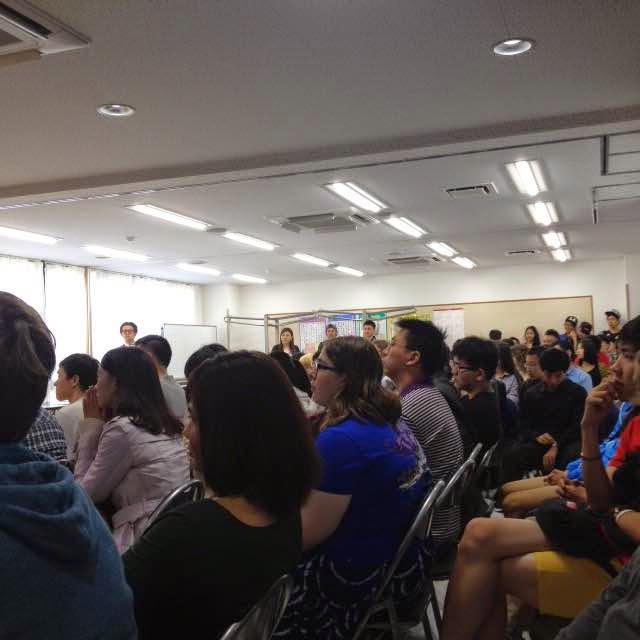
So, after Language school last Tuesday, Katie and I went over to the University as soon as possible. (30 minute trip by train as well as walking.) We then came to the classroom and waited awhile before the teacher gave us permission to speak. The class was an upper-level class about doing researched presentations in English. ( I think it was a combination of advanced speech as well as research.) I was able to give a presentation on the "6 Big Questions" in life. (Refer to my mission trip last year in a previous post http://mtwitnessjapan.blogspot.jp/2013/10/japan-mission-trip-week-1.html to day 3 for the questions.) I also added the question, 'Does God Exist?'. After giving the presentation the professor had the students 
break up into groups and discuss the questions for five minutes each. Katie and I then went around and asked as well as answered questions. (In my interactions I was able to talk about some of the flaws of evolution as well as answer questions about Christianity.) Most students had never really considered the questions before in their lives and did not really know what they believed. They gave the general consensus of what is often said about Japanese people: Shinto, Buddist, and Secular-Humanism all mixed together.  The professor also engaged the students in detail as well.


Katie then gave a personal testimony to the students in Japanese and was able to answer their questions afterwards. I believe the students and professors were impacted by her testimony greatly based upon the response afterward. Later Katie was able to pray over a student. A student also said that he thought many Japanese people would become Christians if we spoke with them one on one and answered their questions, since Japanese are very shy in a group setting. I have also heard that Japanese as a whole are interested in Christianity, but the way their system is structured it makes it difficult to become Christian. We also placed our contact information on the board.


Afterward the professor gave his testimony in Japanese as well. He appeared to be highly encouraged and even offered to take us out to eat afterward. He also said that we were welcome to come back another time and do another presentation. I spoke with a student who was interested in learning more English ( which is common here ) and asked him to consider reading the Bible in English with him. Please pray for him as well as others in the classroom.


Though we have been very pressed by the rigors of language school there are opportunities like this one in Japan by simply being Christian Westerners. If you have any questions or comments feel free to ask. Thank you for your support.


Tuesday, October 14, 2014

October in Japan

Hello everyone! Much has happened since I last posted on this blog. I am now quite over the jet lag as well as sickness and am in the process of adjusting to life in Japan day to day. Also, last weekend we faced some heavy rain, winds, and flooding from the Typhoon, but all is well now. As you can well imagine adjusting to another culture is not easy. Day to day communication is quite difficult, however I am learning new words each day. There have been a few ups and downs with adjusting to the culture as well as big city life. Adjusting can be tiresome, but God is ever present. Mostly my brain has been continuing to get used to new sounds, sights, tastes, and expectations. Here is a link to my video about some Japanese foods:

Japanese Food

Last week Japanese language school just started. My language school, KCP, has about 500 to 600 students and is located near the center of Tokyo in a place called Shinjuku. Every day I get up early and take about an hour train ride into the center of the city to go to school.


Stuffed into the Train


Alley of Shinjuku area


Main street around Shinjuku


There are seven levels of schooling which are supposed to take about two years to complete. Once these levels are complete most people here will be prepared to attend a Japanese college. For most students, this is their chance at a better life since the Japanese standard of living is one of the highest in Asia. My class mostly consists of Chinese and Malaysian students that are about 19-23 years old. (There is also an American, a British man, and a few other southeastern Asians.) Many of these students study Japanese in their home country before coming, do rigorous language school study here, and some work 1-2 jobs at night to pay for everything. They hardly sleep and are in large apartments with a lot of people. For many Asians life is a competition from day one for a better quality of life, so the rigorous schedule of work in Japan is no problem for them. In America it almost seems like we expect a certain level of prosperity without having to work as hard. (40-50 hours a week versus 60+ hours a week, and yes I am not talking about doctors, lawyers, and business owners.) It makes me consider what do we do with our success in America. We have great responsibility to use our resources to further the Kingdom given that most of the world is in some form of poverty. (Luke 12:48)


Orientation at KCP


The Chinese students that I have met are very friendly. I can tell that they have limited access to outside information in their country. (No Facebook, limited internet, gasp!) I sit next to a girl named ‘Jessica’ and a guy named ‘Chris’. They both understand English very well. Jessica speaks English very well and has offered to help me understand any of the Japanese in class since the whole class is in Japanese. Please pray for them as they are from the mainland of China and have likely not heard much of Christianity. I will attempt to befriend them to share the gospel. On a lighter note I met another Chinese guy in class that spoke some English. His first words to me were: “I love United States. I love Michael Jackson and Justin Timberlake.” Our culture definitely reaches people more than anything! The first two days of language school were intense. Please pray that I can understand as well as speak Japanese! Katie has had multiple opportunities for witnessing to people as well as doing some actual bible studies. Please pray for her as well as those she is meeting with!

As many of you have seen on the news, a second typhoon has come through Tokyo bringing much rain and shutting down public transportation for awhile. Hopefully this will be the last Typhoon of the season as the first Typhoon killed 9 people from what I have heard! Also a lunar eclipse occurred with great clarity here in Tokyo!


Lunar Eclipse Photo


 Thank you for your thoughts, support, and prayers as I continue to adjust here!

Tuesday, September 23, 2014

Arrival in Japan

Earlier this week I arrived in Japan after a very long day of travel which began in Montana at about 4:30 A.M. Tuesday (9/16/14) and ended in my apartment in Japan at midnight the next day. Considering that Japan is about sixteen hours ahead of my normal time in Montana it will likely take some time to overcome the jet lag. The flights were not too bad overall. I was able to sit next to a South Korean man who spoke English fairly well. He indicated that he was a minister visiting the United States to talk about his ministry with North Koreans. He spoke about much of what I had previously learned from Voice of the Martyrs (Bible Route to North Korea) about how much of the ministry to North Koreans is done in China. If you are interested in this check out that ministry's Youtube channel. He also indicated how Chinese authorities would beat ministers who were found to try to minister to North Koreans if they were discovered! I gave him my email address and hope to hear more about his ministry.

Since my arrival I have been slowly adjusting to some various differences in culture. This feeling is very disorienting, like I am in a dream-like state. Not only am I not used to living in a new culture, but also I have been adjusting to living in a mega-city. Fortunately, Katie has been here to help me along the way. Much of the Japanese that I have learned has been hard to apply since their communication has various layers of meaning as well as situational usage. My brain has literally been working overtime taking in all of the sights, sounds, and trying to read the language. I am certain that over time this will go away. I will say that each day my brain is very tired!


                                                                 Kodiara Shopping Area


                                                                  Kodiara Station 


My apartment located in Kodiara, Tokyo, Japan is quite nice. I really thought that it would be quite small as well as expensive, but was glad to find out that it was relatively large as well as cheap for what was needed. God really provided! There is plenty of space to work, sleep, prepare food, and store items. It takes about 20 minutes by bike to go to the church and 10 minutes to get to the main train station. I will try to use a bike as much as possible since travel here on the train can get expensive quickly. Fortunately, my language school will be able to provide a discount travel card when I take school associated routes which will save a lot of money.


Apartment Panorama


Being a Westerner is still somewhat of a spectacle in Japan, so some people want to talk and find out who you are and why you are here. I noticed again upon my arrival that people do not generally speak with each other unless some occasion permits them to do so. For instance, when Katie and I went into an organic shop to buy some goods the store owner wanted to talk once a conversation was initiated due to an item purchase. This led to an extensive conversation (20-30 mins) in which this lady claimed interest in visiting our church due to the sign-language program. Also, on another occasion at Starbucks a lady sat next to us but was too shy to say anything the whole time until Katie asked her for some help with directions on a map. This led to her confessing that she was lonely, did not know any foreigners, and wanted to know Katie more. I do not yet know if these people are just being polite, or if they actually want to do things. Only time will tell. Generally in America people will freely talk with one another without an excuse to do so as we are a very out-going type of people. Not so much in Japan.

Recently I met my language partner. His name is Shinya, age 44. He speaks English relatively well since he had lived in the United States for about 4 months. His wife is a Christian who attends the church. We seem to have some commonalities as he studied social psychology in college. I will be spending a lot of time with him. He is not Christian, so please pray for him! I still have some time left before language school starts, so please pray that I continue to adjust!  Also, an exchange student that I helped with English while in Montana named Kobiyashi would like me to speak at his university. His professor is apparently Christian. Please pray for this opportunity coming up soon. Thank you!